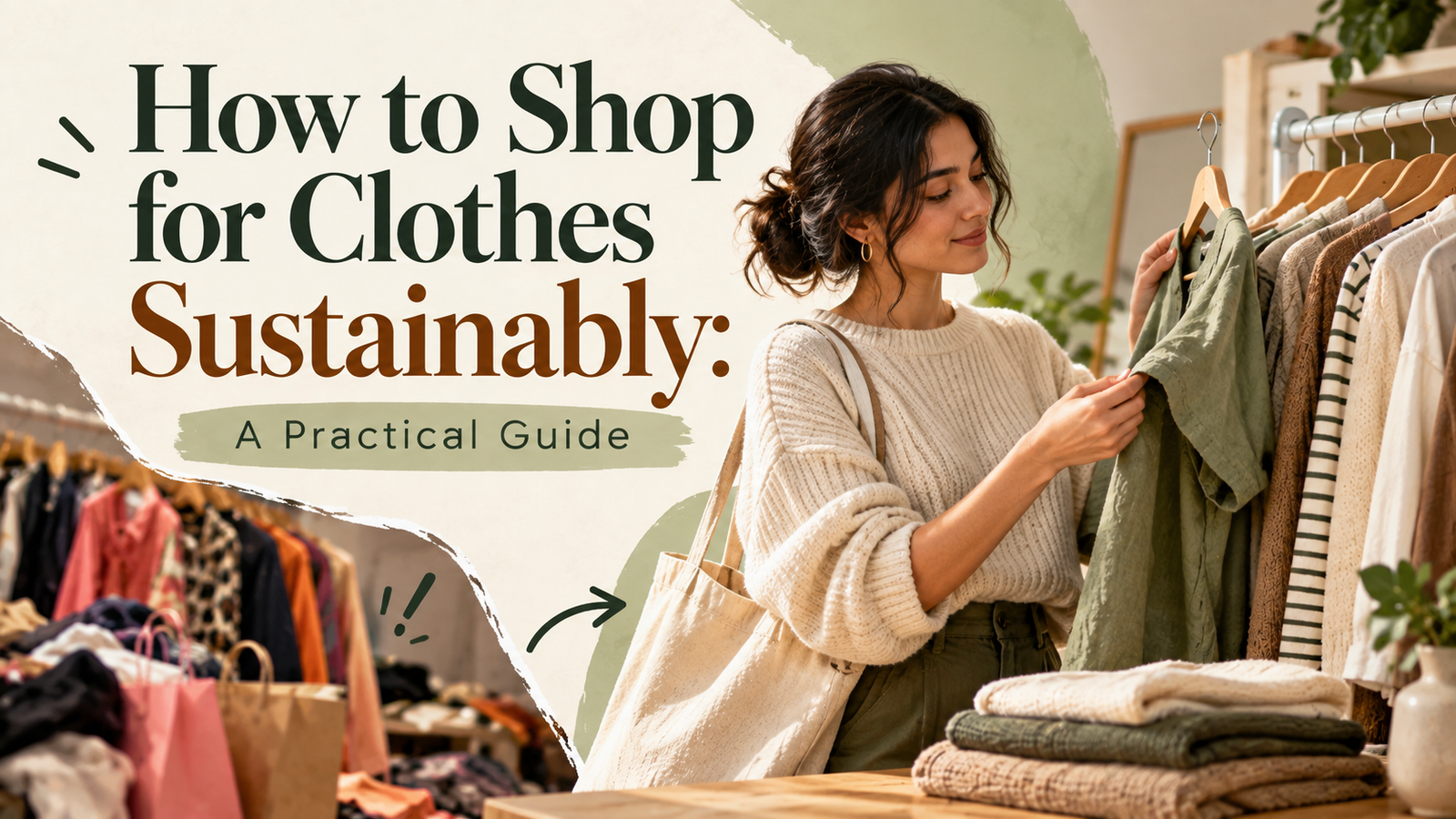
You do not have to choose between a wardrobe you love and a planet you care about. Learning how to shop for clothes sustainably mostly means buying fewer, better pieces, using what you already own, and knowing which labels and fabrics are worth your money.
This guide is for busy people who want clear steps, not guilt. Start with the first three, and add the rest as they fit your life.
Why your clothing choices matter
Clothing is a good place to start because the numbers are large and the habits are simple to change. The EPA estimates that Americans generated about 17 million tons of textiles in 2018, and 11.3 million tons went to landfills. Only about 14.7 percent of textiles overall were recycled, and the figure for clothing and footwear was about 13 percent
You cannot fix that alone, but you do control what you buy next. Every piece you keep wearing, buy used, or skip is one less garment made, shipped, and eventually thrown away.
Designer Vivienne Westwood summed up the approach in a line that is easy to remember: buy less, choose well and make it last. The rest of this guide shows you how to do exactly that, without giving up your style.
How to clothes shop sustainably in 8 steps
Step 1: Start with a 15-minute closet audit
The most sustainable garment is often the one already in your closet. Before you buy anything, pull out what you own and sort it into three piles: wear often, wear sometimes, and never wear.
Look for patterns. Do you keep buying the same color? Are there gaps, such as no good jacket or no versatile shoes? Knowing this keeps you from duplicate purchases. Also set aside anything that needs a small repair or a better fit, since those pieces may be back in rotation for very little money.
Step 2: Know your style before you shop
Good On You, a fashion ratings platform, makes a point that applies to every budget: the first step toward a more sustainable wardrobe is understanding your own style and what you feel happiest in.
A simple way to do it:
- Write down 3 to 5 outfits you actually wear and love.
- Note the colors, fits, and fabrics they share.
- Use that as your filter. If a new piece does not work with at least three things you own, wait.
This is where style and sustainability line up. A closet built around a clear style needs fewer pieces and gets more wear from each one.
Step 3: Buy fewer, better pieces and check the cost per wear
Cheap is not the same as affordable. Divide the price by the number of times you realistically expect to wear a piece.
| Item | Price | Expected wears | Cost per wear |
|---|---|---|---|
| Trendy top | $25 | 5 | $5.00 |
| Well-made top | $60 | 100 | $0.60 |
| Basic jeans | $30 | 30 | $1.00 |
| Durable jeans | $80 | 150 | about $0.53 |
These are illustrative examples, not market prices. Use your own numbers.
Fewer, better-made clothes also tend to look more put together than a larger pile of cheaper ones. That is true even for people on a budget, because you can mix and match fewer items into more outfits.
Step 4: Shop secondhand first
For many pieces, buying used is the lowest-cost, lowest-impact option. Check these first:
- Thrift and consignment shops
- Vintage shops and markets
- Online resale platforms
- Clothing swaps with friends or community groups
Secondhand works especially well for denim, coats, knitwear, and occasion pieces you will wear only a few times. Take a minute to check seams, zippers, underarms, and fabric wear before you buy. For special events, renting can give you something new-feeling without owning it.
Step 5: Read the fabric label
You do not need to memorize every fiber. A few rules of thumb cover most decisions:
| Fabric | What to know |
|---|---|
| Organic, Fairtrade, or recycled cotton | A better pick than conventional cotton, which is resource-intensive to grow |
| Linen and hemp | Generally low-impact fibers that wear well and suit warm weather |
| Lyocell (Tencel) | Made from wood pulp; look for closed-loop production so chemicals and water are reused |
| Recycled wool | Gives existing material a second life |
| Polyester, nylon, acrylic | Made from fossil fuels; best limited where possible, and recycled versions are a better choice when you do need synthetics |
Sources for fabric guidance include Ethical Consumer and Moral Fibres.
Two realistic caveats:
- Natural is not automatically sustainable. How a fiber is grown, processed, and dyed matters as much as the fiber itself.
- Synthetics have a place. For things like rain jackets or workout gear, a durable synthetic you wear for years may be a practical choice. Wash it less and keep it for as long as you can.
Step 6: Use labels, but do not trust vague words
Third-party certifications are more reliable than marketing language. Common ones to look for on clothing:
| Label | What it generally signals |
|---|---|
| GOTS (Global Organic Textile Standard) | Organic fiber and processing standards |
| OEKO-TEX | Tested for harmful substances |
| Fair Trade Certified | Labor and sourcing standards |
| Certified B Corporation | Company-level social and environmental performance |
If you want organic, look for a certified label rather than relying on the brand’s own use of the word.
Step 7: Spot greenwashing in two minutes
Words like “eco,” “conscious,” and “green” are easy to print and hard to verify. Before buying from a brand that markets itself as sustainable, ask:
- Does it name the fabrics and percentages, not only “sustainable materials”?
- Does it say where the clothes are made and by whom?
- Does it share specific facts or goals, not slogans and leaf imagery?
- Does it offer repairs, take-back, or resale?
- Are the prices realistic for the claims? Writer Aja Barber has used the phrase “exploitation prices” for extremely cheap clothing (THE OUTNET).
If a brand cannot answer these, treat the claim with caution.
Step 8: Care for what you buy
A garment’s footprint shrinks the longer you keep it. A few habits help:
- Follow the care label, wash less often, and air dry when you can.
- Fix small problems early: buttons, hems, small tears.
- Use a tailor for fit. Good On You notes that a new zipper or an extra inch on a waistband can cost as little as $30, which is often cheaper than replacing the item.
- When you are done with something, donate, resell, or recycle it. Check what your local donation program accepts.
How to shop sustainable fashion on a budget
A common worry is that sustainable options cost too much. A few ways around that:
- Buy less overall. The cheapest sustainable choice is the item you do not need to buy.
- Go secondhand first. Often the lowest cost per wear.
- Swap and borrow. Clothing swaps and rentals can cover occasion pieces.
- Shop off-season and wait for sales. Plan ahead for coats and boots.
- Tailor instead of replace. Small alterations extend a garment’s life.
- Choose staples. Pieces like everyday boots or a neutral sweater work with many outfits.
Even when sustainably made brands cost more, a cost-per-wear check often shows the gap is smaller than the price tag suggests.
A simple sustainable fashion shopping checklist
Run through this before you buy:
- Do I already own something similar?
- Can I find it secondhand?
- Do I love it, and does it fit well right now?
- Will it work with at least three outfits I already have?
- Is the fabric durable, and is the care reasonable for my routine?
- Are the sustainability claims specific and backed by a trusted label?
- What is the cost per wear if I use it as I expect?
- Can it be repaired or resold later?
If you can say yes to most, you are making a good choice.
Frequently asked questions
Is buying secondhand clothes really more sustainable?
Generally yes, because it keeps an existing garment in use instead of requiring a new one to be made. It works best for items that stay in good condition and fit well.
What are the most sustainable fabrics?
Organic, Fairtrade, or recycled cotton, linen, hemp, recycled wool, and lyocell made in a closed-loop process are commonly recommended. How the fabric is made and dyed matters too.
Are natural fabrics always better than synthetic ones?
Not always. Natural fibers can have heavy water, land, or chemical impacts depending on how they are produced, and a durable synthetic that lasts for years can be a practical choice for some uses.
How can I shop sustainable fashion on a budget?
Buy fewer pieces, start with secondhand, swap or rent for one-off occasions, shop off-season sales, and use a tailor to extend what you own.
How do I spot greenwashing in fashion?
Look for specific details on materials, factories, and certifications. Be cautious about vague words, green imagery, and claims with no evidence behind them.
Final thoughts
Sustainable fashion shopping does not mean a new wardrobe or a perfect closet. It means pausing before you buy, choosing pieces you will actually wear, and keeping them going for as long as you can.
Pick one step from this guide and try it on your next purchase. Over time, those small choices add up to a closet you like more, spend less on, and feel better about.