A Smarter Way to Grocery Shop: Simple Habits That Waste Less
You walk into the grocery store with a list.
Eggs. Vegetables. Coffee. Pasta. Something for dinner.
Then you notice the organic option. There is a product with less packaging beside it. A bulk-size version looks like it might be the better choice. Another product says “sustainable” on the front.
Suddenly, buying groceries feels like it requires a lot more thought than it used to.
If you have ever stood in an aisle wondering whether you are making the “right” sustainable choice, you are not alone.
The problem is not that you do not care. It is that there are too many decisions competing for your attention.
Should you buy local? Organic? In bulk? Packaged or unpackaged? Fresh or frozen? Is that sustainability claim actually meaningful?
You do not need to answer all of those questions every time you shop.
Sustainable grocery shopping can be much simpler when you know which choices are worth thinking about and which ones you can stop overanalyzing.
Here are the habits that can make your regular grocery trip more sustainable without turning it into a research project.
Start With What You Already Have
Before you think about buying something more sustainable, look at what is already sitting in your kitchen.
Open the refrigerator.
Check the freezer.
Look through the pantry.
You are not trying to reorganize everything. You are looking for food that needs to be used.
Maybe you have half a bag of spinach, some leftover rice, a can of chickpeas, two carrots and a jar of pasta sauce.
That is already the beginning of a few meals.
Instead of building your grocery list entirely from scratch, build part of it around what you already own.
The EPA recommends checking your refrigerator, freezer and pantry before shopping, planning meals around food that needs to be used, and buying only what you expect to consume.
Create a “Use First” section on your grocery list
This takes less than a minute.
Add a small section to your phone called Use First.
Then add foods that need attention.
Use First
- Spinach
- Strawberries
- Leftover chicken
- Half an avocado
- Opened yogurt
When you plan your meals, start here.
It changes the question from:
“What do I want to buy?”
to:
“What do I already have that needs a plan?”
That small shift can prevent a surprising amount of unnecessary food from entering your refrigerator.
Plan for Your Real Week
There is a common grocery-shopping mistake that has nothing to do with sustainability.
You shop for the person you hope you will be that week.
The Sunday version of you plans five dinners.
The Wednesday version of you gets home late from work and orders takeout.
By Saturday, the ingredients you bought with good intentions are still sitting in the refrigerator.
Sound familiar?
Instead of planning for your ideal week, look at your actual calendar before making your grocery list.
If you have two late nights, plan easy meals for those days.
If you are going out to dinner on Friday, do not buy fresh ingredients that need to survive until Sunday.
If you usually order takeout once or twice a week, account for it.
The USDA also recommends planning meals and considering how many meals you are realistically going to eat at home before shopping.
Give ingredients more than one job
This is one of the easiest ways to make your grocery list work harder.
Buy spinach for pasta, then use the rest in an omelet or smoothie.
Buy bell peppers for tacos, then use the leftovers in a stir-fry.
Buy Greek yogurt for breakfast, then use it as a dip or sauce.
You are not trying to create a perfect meal plan.
You are making it easier to finish what you buy.
Buy the Amount You Will Actually Use
A larger package can look like the sustainable choice.
Less packaging. Lower price per ounce. Fewer trips to the store.
But there is another question worth asking:
Will I actually finish it?
A giant container of salad greens is not helping much if half of it ends up in the trash.
The same applies to berries, fresh herbs, bread, avocados and other foods that spoil quickly.
When buying in bulk makes sense
Bulk can work well for foods that:
- You use regularly
- Store well
- Have a long shelf life
- You have enough space to store
Rice, oats, pasta, dried beans and some frozen foods can make sense for bulk buying.
For highly perishable foods, buy according to your household size and schedule.
Someone living alone may have very different grocery needs from a family of four.
The better question is not “Is bulk more sustainable?”
It is:
“Will buying this much help me use more of the food, or will it leave me with more to throw away?”
Look at the Food Before You Look at the Packaging
Packaging matters.
But it should not be the only thing you consider.
Imagine you are choosing between two similar products.
One has slightly less packaging.
The other is packaged in a way that makes it much easier for you to store and use.
You know you will finish the second one.
That matters too.
The EPA points out that when food is wasted, the resources used to produce, transport and store that food are wasted too.
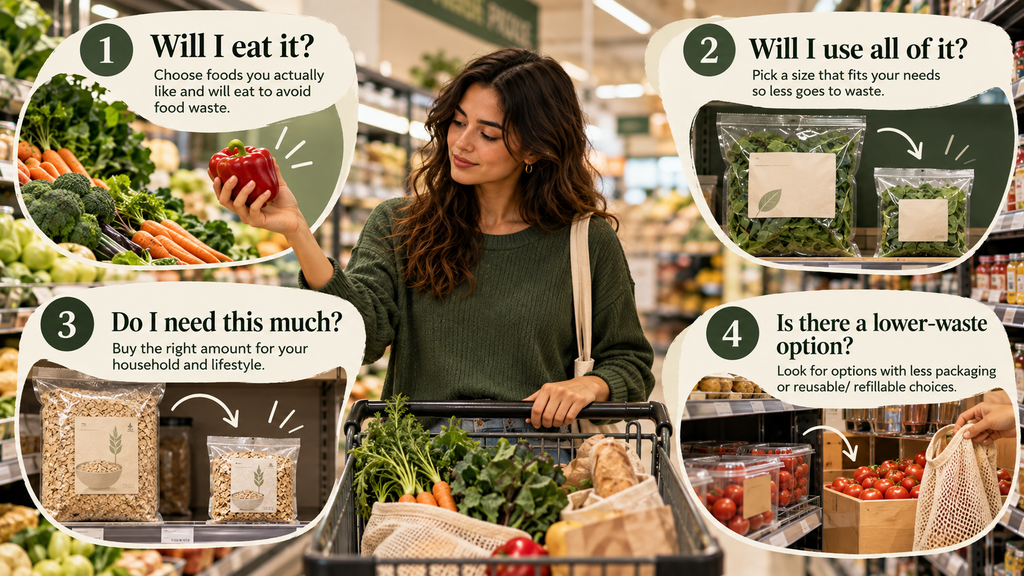
So before choosing between two products, ask yourself:
- Will I eat this?
- Will I use all of it?
- Do I need this much?
- Is there an easy lower-waste option?
If you can answer those four questions, you have already simplified a lot of the decision-making that makes sustainable grocery shopping feel complicated.
Be Careful With Sustainability Claims
Walk through a grocery store and you will find plenty of words that sound environmentally responsible.
“Natural.”
“Clean.”
“Green.”
“Eco-friendly.”
“Sustainable.”
The problem is that a word on the front of a package does not necessarily tell you what happened behind the product.
That is why it is worth learning about the labels that actually matter for the products you regularly buy.
The FoodPrint Food Label Guide is a useful resource for understanding common food certifications and what they actually mean.
You do not need to memorize every certification in the supermarket.
If you regularly buy seafood, learn the labels relevant to seafood.
If coffee is a daily purchase, learn the certifications used for coffee.
If organic food matters to you, understand what the USDA Organic label represents.
That is enough.
You are trying to become a more informed shopper, not a food-label expert.
You Do Not Have to Buy Everything Organic
Organic food is often treated as though it is synonymous with sustainable food.
It is not that simple.
Organic certification covers specific production standards, while sustainable grocery shopping involves many different decisions.
You can make your grocery routine more sustainable by:
- Wasting less food
- Buying only what you will use
- Eating more plant-based meals
- Choosing seasonal foods when practical
- Using frozen produce when it helps prevent waste
- Avoiding unnecessary packaging
- Learning meaningful certifications
- Supporting producers whose practices align with your priorities
If organic products fit your preferences and budget, great.
If they do not, that does not mean you cannot shop sustainably.
Try Adding More Plant-Based Meals
You do not need to completely change your diet.
Start with one meal.
If you normally make chili with mostly meat, add more beans and vegetables.
If tacos are a regular dinner, try black bean tacos one night.
If you make stir-fry with chicken, try tofu or extra vegetables.
Some easy meals to experiment with include:
- Black bean tacos
- Lentil soup
- Chickpea curry
- Vegetable stir-fry
- Bean and rice bowls
- Pasta with vegetables and white beans
- Tofu fried rice
The important part is finding meals you genuinely enjoy.
A sustainable habit you dislike will be difficult to maintain.
A meal you already look forward to eating can become part of your normal routine without requiring much thought.
Keep Frozen Foods in Your Toolkit
Fresh produce is not automatically the better choice if you repeatedly buy more than you can eat.
Frozen foods can be useful when your schedule changes or when you do not use certain ingredients often enough to justify buying them fresh.
Think about frozen:
- Berries
- Peas
- Spinach
- Corn
- Mixed vegetables
- Fruit
- Herbs
Frozen food gives you flexibility.
You can keep ingredients available without worrying that everything has to be used within the next few days.
For someone with a busy schedule, that can make sustainable eating much easier to maintain.
Give Imperfect Produce a Chance
A crooked carrot still works in a soup.
A misshapen potato still makes dinner.
A banana that has become too soft for your lunchbox can become part of a smoothie or banana bread.
The EPA recommends considering imperfect produce as one way to help prevent food waste.
If your grocery store has a discounted produce section, take a look.
You might find:
- Misshapen vegetables
- Slightly bruised fruit
- Overripe bananas
- Produce that needs to be used soon
Sometimes the less attractive option is exactly what you need for tonight’s dinner.
Choose Seasonal Food When It Makes Sense
Seasonal shopping can be a useful part of sustainable grocery shopping, but it does not need to become another rule you have to memorize.
Look at what is available, affordable and appealing.
If apples are plentiful in the fall, buy apples.
If fresh berries are expensive in winter, frozen berries may make more sense.
If your local farmers market has seasonal produce that you enjoy and it fits into your routine, shop there.
If getting there requires a long drive every weekend, you do not have to force it.
Your shopping habits need to fit into your actual life.
Do You Need to Shop at Farmers Markets?
No.
Farmers markets can be a great option for seasonal produce and for learning more about where your food comes from.
But they do not need to replace your regular grocery store.
You can split your shopping based on what works best for you.
Farmers market: Seasonal produce
Supermarket: Pantry staples, dairy and everyday groceries
Local store: Products you prefer to buy locally
Freezer: Foods that help you avoid wasting fresh ingredients
There is no requirement to get everything from one place.
A complicated routine is not automatically a more sustainable routine.
Make Your Reusable Bags Easier to Remember
Reusable bags are useful.
Remembering them is the difficult part.
Instead of buying more bags every time you forget them, make the ones you already own easier to remember.
If you drive, keep them in your trunk.
If you walk, keep one folded bag in your everyday bag.
If you order groceries for pickup, put your bags beside the door before leaving.
You can also attach the habit to something you already do.
Keys → wallet → grocery bags → leave home
And if you forget them?
Use the practical option available that day.
One forgotten bag does not undo the rest of your efforts.
Sustainable Shopping Should Not Become Another Source of Guilt
There is a difference between caring about sustainability and having the time and energy to optimize every grocery decision.
Real people have jobs, commutes, families, changing schedules and days when cooking simply does not happen.
One U.S. Reddit discussion about sustainable shopping captured this tension with a commenter saying they were “too busy trying to sustain my dwindling bank account” to worry about sustainability at the grocery store. Read the Reddit discussion.
The comment is funny, but the underlying point is worth considering.
If sustainable living constantly feels like another test you can fail, it becomes much harder to build habits that last.
You will forget your reusable bags.
You will buy packaged food.
You will order takeout.
You will have a week when the meal plan falls apart.
That is normal.
The useful question is:
What can I make easier to do consistently?
A Simple Sustainable Grocery Checklist
Before leaving home:
- Check your refrigerator
- Check your freezer
- Check your pantry
- Look at your schedule
- Plan a few realistic meals
- Write down what you actually need
At the store:
- Buy food you are likely to eat
- Choose realistic quantities
- Consider seasonal options
- Add plant-based meals when they work for you
- Look past vague sustainability claims
- Choose lower-waste options when they are practical
- Avoid buying extra simply because a product is on sale
After shopping:
- Put food that needs to be used soon somewhere visible
- Store produce properly
- Freeze food you will not use soon
- Keep leftovers easy to see
- Use what you already have before buying more
You do not need to do every one of these perfectly.
Pick a few.
Repeat them.
Let the routine become automatic.
Your Next Grocery Trip
You do not need to completely change the way you shop.
Before you leave home, look through your refrigerator, freezer and pantry.
Check your schedule.
Plan a few meals.
Write down what you actually need.
Then, when you are standing in the grocery aisle, ask yourself:
Will I eat this?
Will I use all of it?
Do I need this much?
Is there an easy lower-waste option?
You do not need the perfect answer every time.
Maybe this week you buy less fresh produce because you know you have a busy schedule.
Maybe next week you try a plant-based dinner.
Maybe you finally use the reusable bags sitting in your trunk.
Maybe you simply finish the food already in your refrigerator before buying more.
Those choices can look small when you make them one at a time.
Repeated over weeks and months, they can change the way you shop.
That is what sustainable grocery shopping can look like in real life: not a perfect cart, but a more thoughtful one.
Frequently Asked Questions
What is sustainable grocery shopping?
Sustainable grocery shopping means making food-buying choices that reduce unnecessary waste and environmental impact while fitting your actual eating habits and lifestyle.
How can I grocery shop more sustainably?
Start by checking what you already have, planning realistic meals, buying what you will use, reducing unnecessary packaging and choosing more plant-based foods when practical.
Is buying in bulk more sustainable?
It can be, especially for foods you regularly use and store well. Buying more is not helpful if a large portion ends up going to waste.
Is local food always more sustainable?
No. Local food can have benefits, but sustainability also depends on production methods, transportation, seasonality and whether the food gets eaten.
Is organic food more sustainable?
Organic is one part of sustainable food shopping, not the entire picture. Food waste, dietary choices, packaging and purchasing habits also matter.
How can I reduce plastic when grocery shopping?
Choose loose produce when practical, avoid unnecessary packaging and use reusable shopping bags you already own. Focus on changes that do not create additional food waste.
Do reusable produce bags really help?
They can reduce the use of single-use produce bags, but you do not need to buy new products to become a more sustainable shopper. Use what you already have when possible.
What should I buy in bulk?
Choose bulk quantities for foods you use regularly and can store well, such as rice, oats, pasta and dried beans. Be more cautious with foods that spoil quickly.
Is frozen food sustainable?
Frozen food can help reduce waste because it gives you more time to use ingredients. Frozen fruits and vegetables can be particularly useful for busy households.
How can I reduce food waste while shopping?
Check your kitchen before shopping, plan meals around food that needs to be used, buy realistic quantities and avoid purchasing ingredients for meals you are unlikely to make.
What is the most sustainable grocery choice?
There is no single answer. A good starting point is buying food you will actually eat, reducing food waste and making lower-impact choices that fit your routine.
Do I need to shop at farmers markets?
No. Farmers markets can be useful, but you can make more sustainable choices at a regular supermarket too.
How do I know if a food label is sustainable?
Look beyond broad claims such as “natural” or “eco-friendly.” Learn what relevant certifications actually require and whether they are independently verified.
What should I prioritize when grocery shopping?
Start with three things: buy what you will eat, reduce food waste and make a few sustainable choices that you can realistically repeat.